
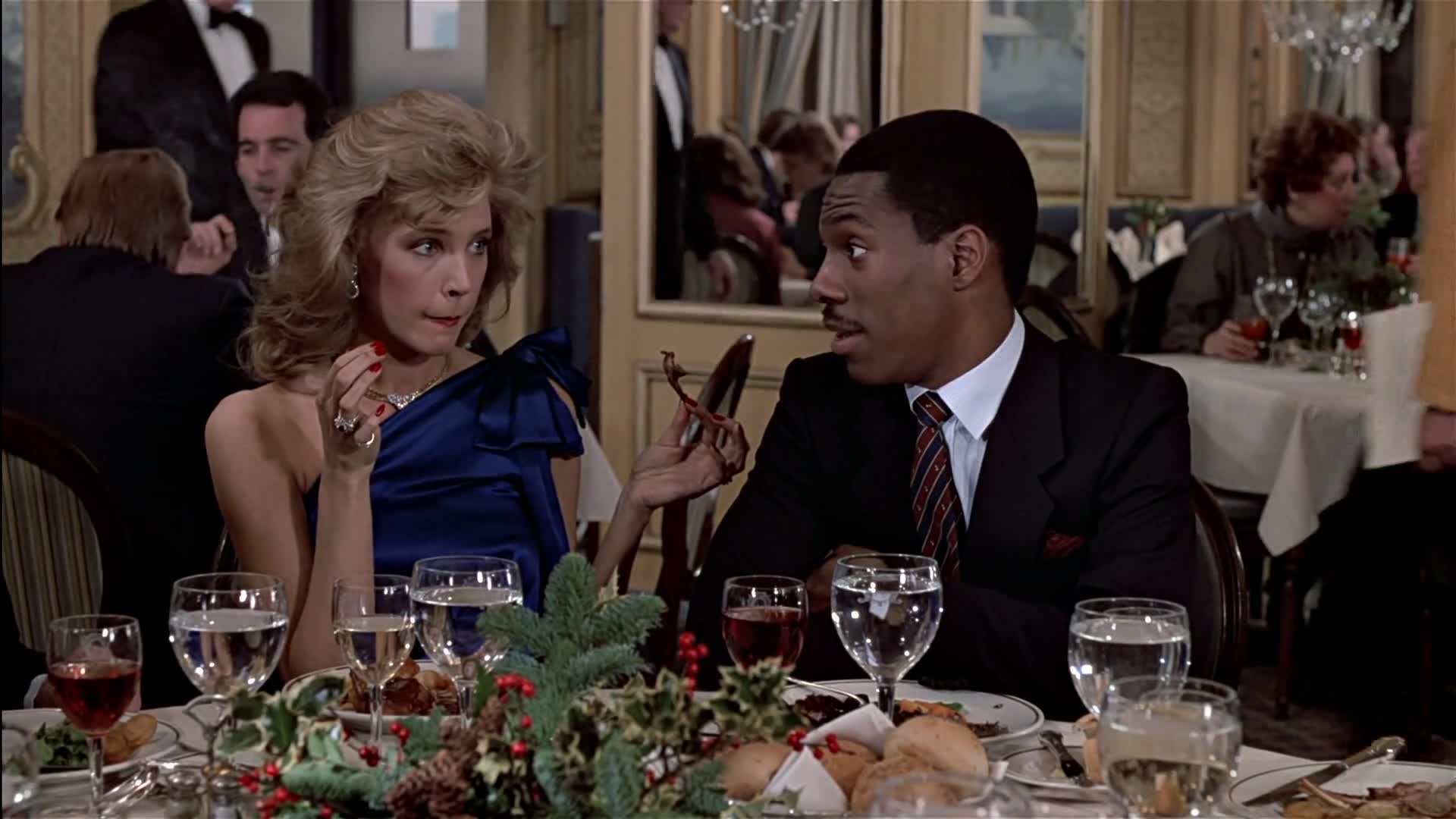
Despite the elements that some people may find offensive today, I still think this movie works as a sharp and very funny satire.
Is 1983’s Trading Places technically a Christmas movie? Probably not. Honestly, it’s even less of a Christmas movie than Die Hard. That said, it does take place around the holidays, so I watched it with that mindset and here are my thoughts.
First and foremost, I don’t think this is a movie that could be made today. The basic plot revolves around two extremely wealthy brothers, Randolph and Mortimer Duke (played by Ralph Bellamy and Don Ameche), who decide to settle a bet about nature versus nurture. They deliberately destroy the life of a privileged white stockbroker, Louis Winthorpe III (Dan Aykroyd), and replace him with Billy Ray Valentine, a poor Black man played by Eddie Murphy, to see which theory wins out.
Randolph believes environment shapes character, while Mortimer believes genetics do. Mortimer’s worldview leads to some very uncomfortable dialogue — most notably a line that absolutely would not fly today. Even in context, it’s jarring, and modern audiences will likely find parts of this movie problematic or offensive. Back in 1983, that wasn’t the case, but time has definitely changed how this material lands.
What I find interesting is that even the Blu-ray packaging avoids describing the actual plot. Instead, it gives a vague, feel-good summary about “comic geniuses” and “high stakes.” If you went into this movie blind and were particularly sensitive to older humor, you might be caught off guard.
That said, it didn’t offend me. I think Trading Places is hilarious.
The cast is fantastic. Dan Aykroyd and Eddie Murphy are both at the top of their game here, and their chemistry is excellent. Bellamy and Ameche are perfect as crotchety, out-of-touch rich guys, and Jamie Lee Curtis is great as Ophelia, the prostitute who helps Winthorpe when he hits rock bottom. Denholm Elliott is also memorable as Coleman, the loyal butler who seamlessly shifts allegiances as the social experiment unfolds.
Despite the elements that some people may find offensive today, I still think this movie works as a sharp and very funny satire. A lot of what it says about class, privilege, and the absurdity of wealthy elites still rings true. Whether you enjoy it or not will really depend on the lens you view it through — whether you can accept it as a product of its time or judge it entirely by modern standards.
I can still watch it and enjoy it for what it is. I saw it in theaters when it first came out, and I’m not looking to turn it into some grand political or racial statement. At the end of the day, it’s a comedy. It’s meant to be funny. So relax, don’t take it too seriously, and just enjoy the ride. It’s one of the best films in both Eddie Murphy’s and Dan Aykroyd’s careers, and a strong entry in John Landis’ filmography, controversies aside.
So yes, it’s an unconventional Christmas movie that isn’t really a Christmas movie, and still entertaining more than 40 years later.
4.0 out of 5.0 stars

