
Harold and Maude is not a film that would likely be made today—not just because of its age-gap romance, but because its tone, pacing, and themes are so utterly unconventional.
Harold and Maude is a film that’s long been on my to-watch list, and after finally sitting down with it, I can confidently say it’s one of the most unique, surprising, and strangely heartwarming movies I’ve seen in a long time.
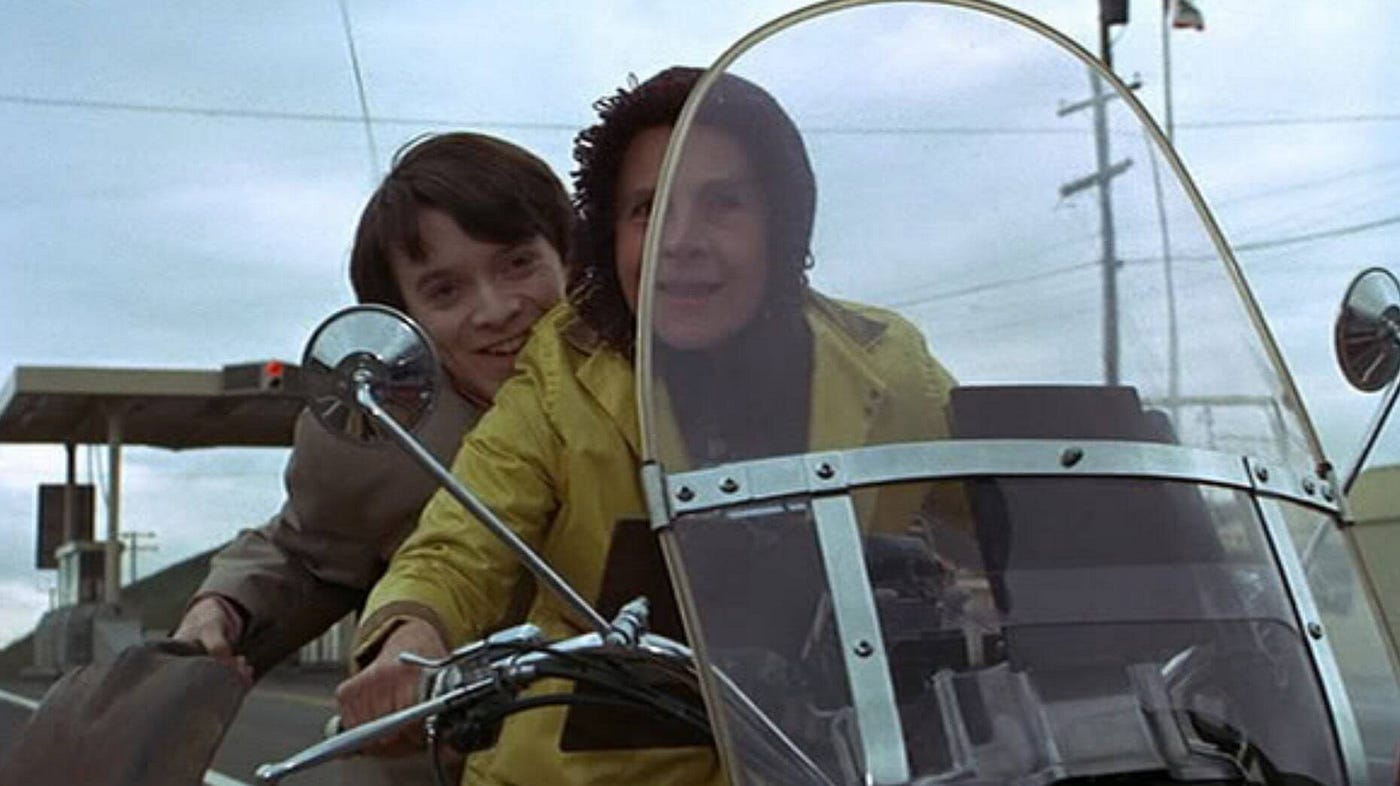
At the heart of Harold and Maude is a deeply unusual relationship between Harold (Bud Cort), a morbid, emotionally detached 20-year-old, and Maude (Ruth Gordon), an exuberant 79-year-old with a passion for life. The two meet at a funeral—a hobby they both share, though for wildly different reasons. Harold, obsessed with death, attends funerals of strangers and stages elaborate fake suicides to get a rise out of his indifferent mother. Maude, on the other hand, attends to celebrate life, showing up in bright clothes and carrying a yellow umbrella.
Their friendship begins awkwardly but quickly evolves into something deeper, more symbiotic. Maude’s boundless optimism slowly pulls Harold out of his morose shell, while Harold’s deadpan demeanor is both challenged and enriched by Maude’s philosophy of living each day fully.
Bud Cort’s performance as Harold is a revelation. While I’ve seen him in other roles, nothing stuck until now. His blank expressions and comedic timing give depth to a character that could have easily felt one-note. Ruth Gordon, meanwhile, is magnetic as Maude. Even when the script doesn’t quite flesh out her character’s “life-affirming” spirit as well as it could have, Gordon fills in the blanks with sheer presence and warmth.
Vivien Pickles, who plays Harold’s controlling and aloof mother, deserves special mention. Her comedic timing and subtle reactions provide a foundation for Harold’s neuroses. And for fans of deep cuts, Tom Skerritt has a fun cameo as a motorcycle cop, credited under the name “M. Borman”—a nod you can look up on IMDb for a laugh.
Director Hal Ashby, known for Being There (a personal top-four film of mine), brings a calm, surreal quality to Harold and Maude. He handles the film’s strange tone with precision, allowing its darkest moments to coexist with its funniest. One scene in particular—where Harold stages a suicide by setting himself on fire in the background—is so visually absurd that it becomes laugh-out-loud hilarious. It’s these carefully constructed contrasts between morbidity and humor that make Ashby’s direction so effective.
Let’s address the elephant in the room: the relationship. A romance between a 20-year-old man and a 79-year-old woman isn’t just rare—it’s jarring, and admittedly may strike some viewers as off-putting or even “icky.” But if you can move past the surface shock, Harold and Maude reveals itself as a profoundly human film. It’s about finding joy in the face of death, forming connection in unlikely places, and learning how to live when all you’ve known is emptiness.
This is dark comedy at its finest. And yes, the humor is extremely black—if fake suicides and death-obsessed dates don’t sound funny to you, this may not be your cup of tea. But if you enjoy films that take big risks and blur emotional lines, you’re in for something special.
Harold and Maude is not a film that would likely be made today—not just because of its age-gap romance, but because its tone, pacing, and themes are so utterly unconventional. And yet, it’s precisely this uniqueness that makes it worth watching. It’s weird, warm, unsettling, and often hilarious. While I found the character of Maude underwritten in places, Ruth Gordon’s performance more than compensates.
This is a film that lingers—oddly uplifting and quietly devastating. A cult classic for good reason, and a movie I look forward to revisiting.
4.5 out of 5.0 stars

