
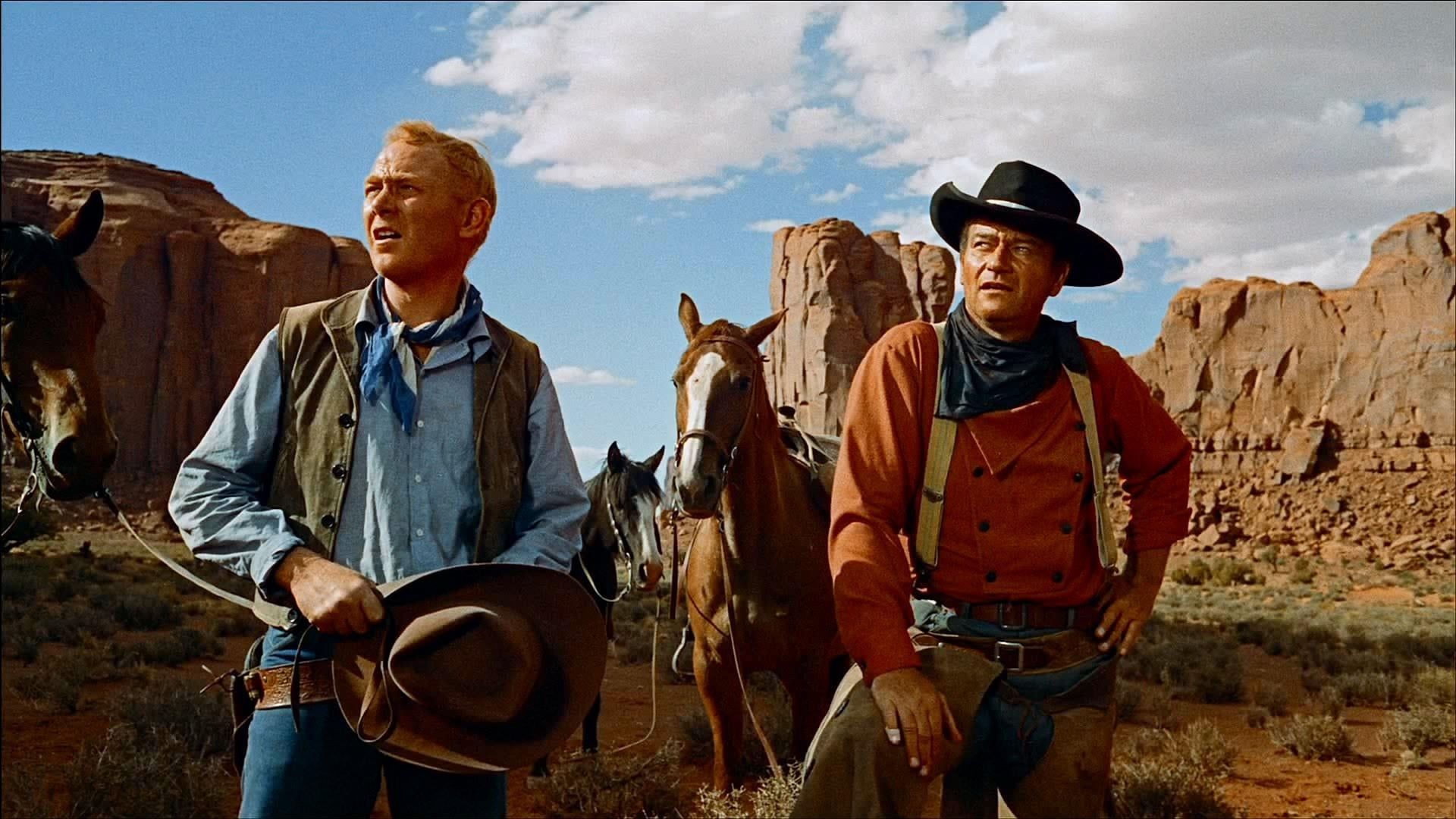
John Wayne delivers one of the most layered and challenging performances of his career.
John Ford’s The Searchers is often cited as one of the most important Westerns in cinematic history. After finally sitting down to watch it this summer, I now understand why. Even with limited prior exposure to the genre, I was immediately struck by its visual grandeur, narrative depth, and the raw emotional tension running beneath the dusty surface. This isn’t just a Western—it’s a film that grapples with obsession, revenge, and the dark undercurrents of American mythology.
Set in post–Civil War Texas, The Searchers centers on Ethan Edwards (John Wayne), a Confederate veteran who returns to his brother’s homestead. When a Comanche raiding party attacks the property and kidnaps young Debbie (Natalie Wood), Ethan and her adopted brother, Martin Pawley (Jeffrey Hunter,) set off on a search that spans years and thousands of miles. Their quest slowly transforms from a rescue mission into something more unsettling, as Ethan’s prejudice and personal demons threaten to consume them all.
Wayne delivers one of the most layered and challenging performances of his career. Ethan is no clean-cut cowboy—he’s brooding, angry, and deeply racist. It’s uncomfortable, but that discomfort feels intentional. Wayne portrays Ethan as a man hardened by war and personal loss, incapable of adapting to a world that has moved on without him. Hunter plays the moral compass of the film. As Ethan’s foil, Martin is empathetic and emotionally grounded. His devotion to rescuing Debbie is the film’s heart, providing hope amidst Ethan’s increasingly vengeful obsession.
Vera Miles is endearing as Laurie Jorgensen, bringing humor and tenderness to the story. Natalie Wood’s role as the kidnapped Debbie is brief but pivotal. Meanwhile, Ward Bond, Henry Brandon (as Comanche chief Scar), and other supporting players flesh out a rugged, authentic frontier world. (Brandon, a white actor, playing a Native American character reflects Hollywood’s racial casting norms of the 1950s. While problematic today, it’s an important aspect of the film’s historical context.)
John Ford’s direction is nothing short of legendary. Filmed in VistaVision, the cinematography by Winton C. Hoch captures Monument Valley in all its stark beauty. Every shot feels composed like a painting—wide, contemplative, and loaded with subtext. Ford’s use of space, silence, and static composition allows the landscape to become a character itself. The rugged terrain mirrors Ethan’s inner desolation, while the harsh lighting and deep shadows reflect the film’s moral ambiguity.
Made in 1955 and released in 1956, The Searchers is very much a product of its time—yet it wrestles with themes far ahead of it. Ethan’s racism isn’t glorified; it’s portrayed as a corrosive force that isolates him from others and nearly destroys what’s left of his family. The film invites viewers to consider what happens when vengeance replaces justice—and when hate becomes identity.
That said, modern viewers will likely find moments of the film troubling, especially in its portrayal of Native Americans and the absence of authentic Indigenous voices. But rather than dismiss it, I believe it’s important to examine the film critically—acknowledging both its achievements and its flaws.
While Sergio Leone’s Once Upon a Time in the West might remain my personal favorite Western, The Searchers earns its place as a genre-defining work. It’s not always comfortable, but that’s part of its power. With John Wayne’s unsettling turn as Ethan, Ford’s lyrical storytelling, and unforgettable visuals, this is a film that lingers long after the credits roll.
4.5 out of 5.0 stars

