
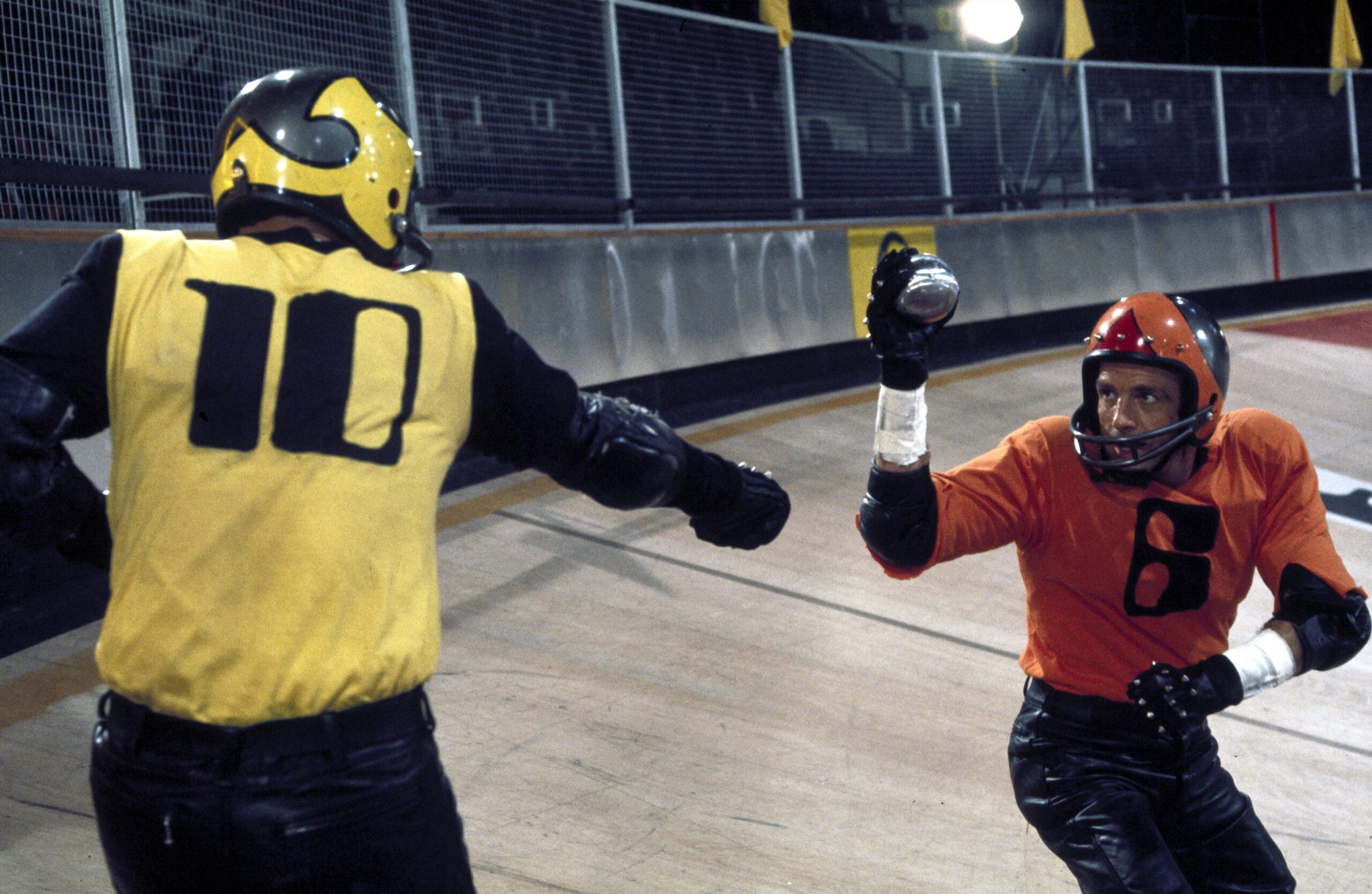
The film’s opening sequence immediately hooked me: a fifteen-minute introduction to Rollerball itself with no dialogue or exposition.
Going in, I was expecting a brutal futuristic sports movie centered around the game of Rollerball—complete with spiked gloves and violent action. While the film certainly delivers on that front, what I got was much more than just a violent spectacle. Norman Jewison’s Rollerball surprised me with how introspective and thought-provoking it is, diving deep into themes of individual freedom versus comfort in a corporate-controlled world.
The story takes place in the filmmakers’ vision of 2018, where poverty and disease no longer exist, but at a cost: corporations run everything after a series of “corporate wars.” Each corporation monopolizes a specific industry and controls entire regions of the world. Traditional war has been replaced by the sport of Rollerball, which is designed to reinforce the idea that no single individual can rise above the group.
James Caan stars as Jonathan E, a player for Houston who becomes a star in the sport—something the system was built to prevent. When Bartholomew (John Houseman), the head of the Energy Corporation, urges him to retire, Jonathan resists. That defiance puts him on a collision course with the powers that be, especially with the championship on the line.
The film’s opening sequence immediately hooked me: a fifteen-minute introduction to Rollerball itself with no dialogue or exposition. It just throws you into the game, letting you figure out the rules and brutality through pure action. For 1975, the action scenes are impressive, and even now they carry real impact.
Where the movie shines is in its social commentary. It explores a chilling vision of a world where comfort and security come at the expense of personal freedom. People’s relationships, careers, and even love lives are dictated by corporations, stripping away individuality. Those ideas feel even more relevant when comparing 1975’s version of 2018 to where we are in 2025. Honestly, it feels like we’re uncomfortably close to the world this movie imagined.
If there’s a weak point, it’s in the more introspective, character-driven stretches where Jonathan reflects on what he’s lost. Those moments don’t land quite as strongly as the broader social questions. Still, James Caan gives a strong, understated performance, and John Houseman is excellent as Bartholomew—even if I couldn’t stop noticing his wild nose hair the whole time.
I haven’t seen the 2002 remake, but from what I’ve heard, it strips away all the thoughtful elements that make the original so effective, leaving just a hollow action movie. Honestly, that doesn’t surprise me.
In the end, I really enjoyed Rollerball. It’s the kind of movie that sticks with you, and I suspect I’ll notice even more subtext and symbolism on a re-watch. If you haven’t seen it, I definitely recommend giving it a chance—not just for the action, but for its unsettlingly relevant vision of the future.
3.5 out of 5.0 stars

