
It’s an overlooked relic of late-’80s genre film-making that’s far more charming and entertaining than it has any right to be.
1989’s Warlock is one of those movies that somehow managed to hide in plain sight for years. Despite being a constant presence on cable TV and a staple of video store shelves, it was easy for me to dismiss at a glance. I thought it’d be either too silly, too fantasy-heavy, or just not quite my thing. Fantasy isn’t usually my go-to genre, so this was a title I kept passing over. After finally sitting down with it, I’m happy to say that I was pleasantly surprised.
What Warlock delivers is a delightfully goofy supernatural action film that never takes itself too seriously, yet plays its material with enough earnestness to make it work. While it was marketed as a horror movie, it’s really more of a fantasy-action hybrid with some light gore sprinkled in. The tone strikes a nice balance: there’s just enough cheese to keep things fun without tipping fully into parody.
The story follows Julian Sands as an unnamed warlock who escapes execution in 17th-century New England by fleeing through a time portal into 1988 Los Angeles. His goal is to reunite the three pieces of the Grand Grimoire, a satanic text that contains the hidden name of God. If spoken in reverse, that name will undo all of creation. Chasing him through time is Giles Redfern (Richard E. Grant), a witch hunter who failed to execute the warlock centuries earlier. Along the way, Redfern teams up with Cassandra (Lori Singer), a ditzy young woman cursed by the warlock to age twenty years every day.
Structurally, the film feels a bit like a fantasy-flavored Terminator. One character hunts another across time, racing to prevent a catastrophic future. The comparison mostly ends there, though. Warlock has its own unpredictable rhythm thanks to its loose, almost casual approach to magic. The film rarely explains how or why its spells work. You’re simply expected to accept things like magic compasses made from blood or characters stuffing pennies into their mouths for protection. Surprisingly, that lack of explanation becomes part of the charm. You either roll with it and have fun, or you don’t.
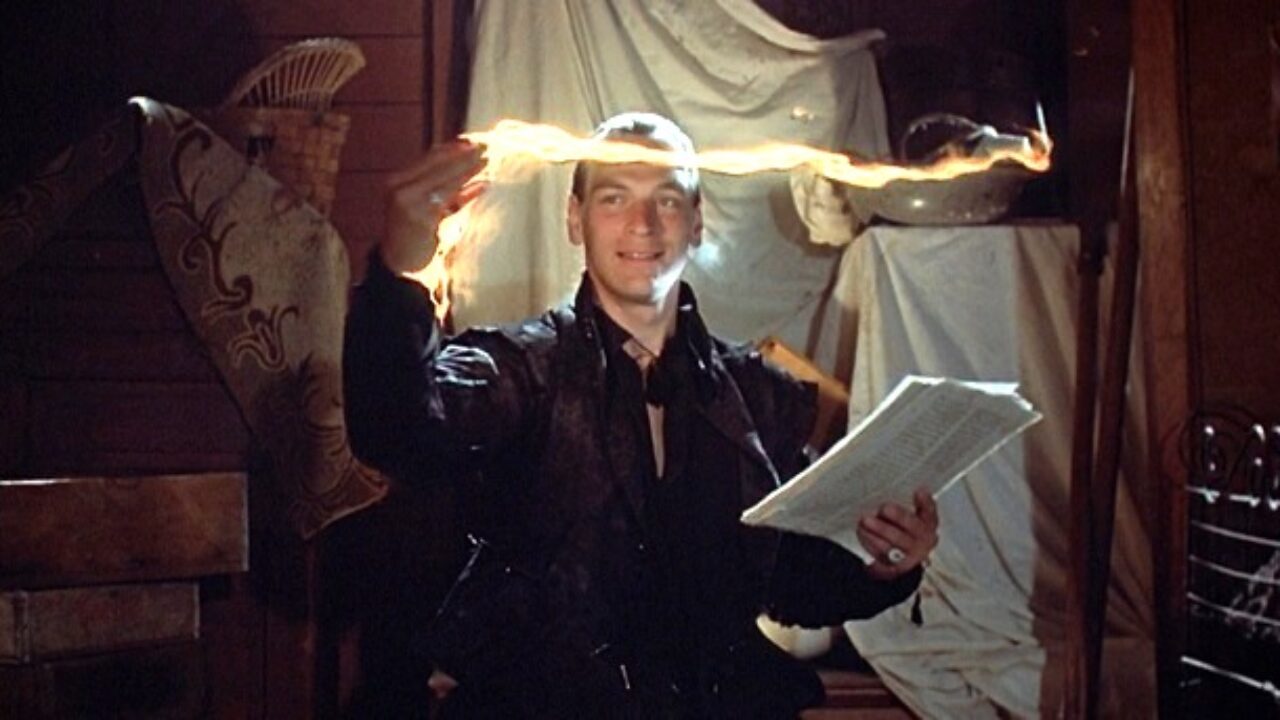
The special effects have definitely aged, and in some cases, they’ve aged poorly. But there’s an undeniable pre-CGI ’80s charm to them. The animated fire effects, in particular, look more like something out of a cartoon than real flames, yet they give the movie a distinct visual personality that modern effects often lack.
One of the most interesting aspects of Warlock is its villain. Julian Sands doesn’t play the warlock as a cool, charismatic anti-hero. Instead, he’s genuinely repulsive. It’s one of those rare ’80s genre films where you’re firmly rooting for the heroes rather than secretly admiring the bad guy. That choice adds an unexpected warmth and sincerity to the film.
The pacing does stumble at times, with a repetitive “move to a location, do a thing, move to another location” structure that could have used some tightening. Still, those issues don’t outweigh how enjoyable the experience is overall.
Warlock ended up being a genuine surprise. It’s an overlooked relic of late-’80s genre film-making that’s far more charming and entertaining than it has any right to be.
3.5 out of 5.0 stars

