
For anyone willing to explore classic cinema, it’s an engaging and rewarding watch—especially as a showcase for Humphrey Bogart’s late-career work.
This time I’m diving into the 1955 thriller, The Desperate Hours, a tense home invasion drama starring Humphrey Bogart, Fredric March, Arthur Kennedy, and Martha Scott.
This was one of Bogart’s final films before his death in 1957, and speaking as someone still exploring his filmography beyond classics like Casablanca and The Maltese Falcon, this was a great reminder of just how commanding he could be on screen.
The story centers on Glenn Griffin (Bogart), the leader of three escaped convicts who take over a suburban Indianapolis home belonging to the Hilliard family. What follows is essentially a prolonged hostage situation: the criminals are waiting for a package that will allow them to escape, and until it arrives, the family must go about their daily lives without alerting anyone or risk deadly consequences.
Despite its relatively simple premise, the film sustains tension remarkably well across its 115-minute runtime. It’s a slow-burn standoff where the suspense comes not from action, but from uncertainty—who will break, who will survive, and how this powder keg situation will ultimately explode.
The family dynamic plays an important role in grounding the story. Fredric March’s Dan Hilliard is the steady patriarch trying to balance compliance with resistance, never quite sure when to push back. Martha Scott’s Ellie is the emotional anchor, focused entirely on keeping her family safe. Meanwhile, the children each represent different responses to the crisis: the young son idolizing his father but struggling with fear, and the daughter Cindy bringing a volatile, unpredictable energy that adds another layer of tension.
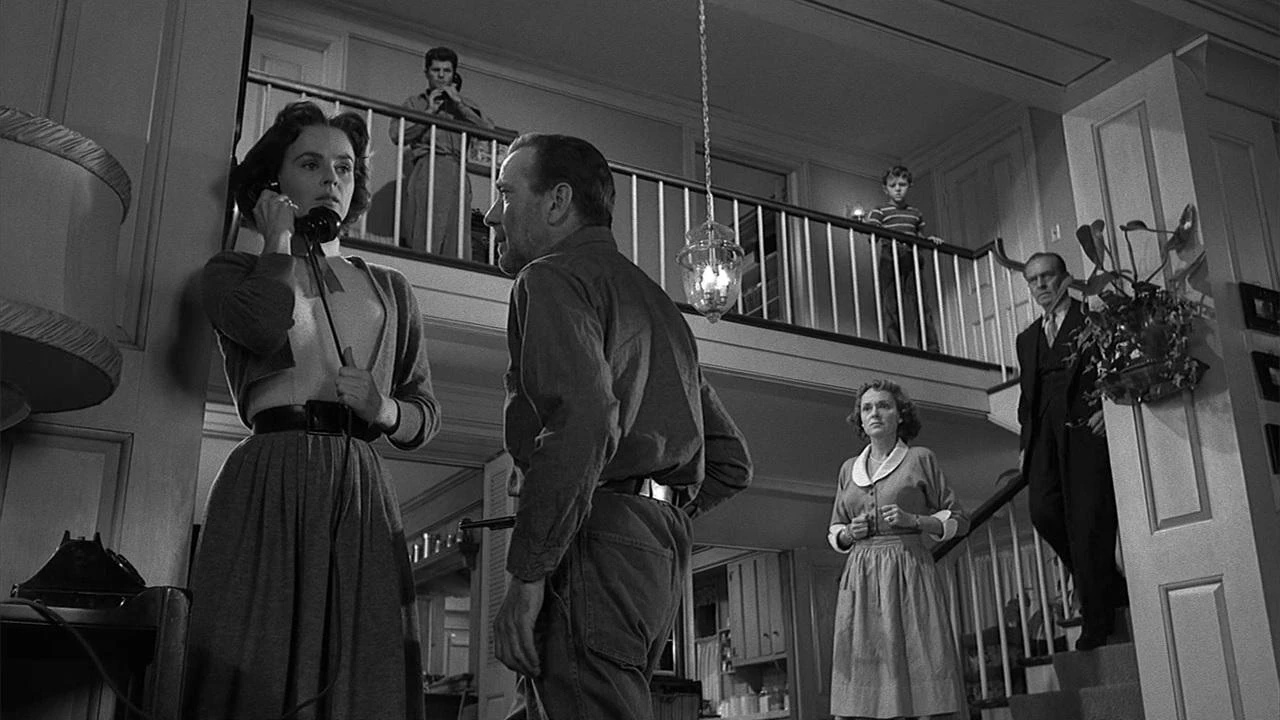
Visually, the film is more dynamic than you might expect from a 1950s thriller. Director William Wyler makes great use of close-ups to capture the characters’ emotional states, while wider shots often stage multiple characters across different levels of the house, allowing their body language and interactions to play out simultaneously. It’s a smart use of space that keeps the film visually engaging.
But the real standout here is Bogart. His portrayal of Glenn Griffin is layered—he’s calculating, hardened, and dangerous, but there are glimpses of something more beneath the surface. He’s not a one-note villain; there’s intelligence and even a warped sense of fairness to him, which makes his sudden bursts of anger all the more unsettling. His scenes opposite March are especially compelling, as the two actors play off each other with a mix of restraint and intensity.
The supporting criminals don’t leave quite the same impression, functioning more as archetypes—the impulsive younger brother and the brutish muscle—but they serve their purpose within the story.
The script is sharp, with memorable dialogue that adds personality to the tension. Moments of dark humor and character insight help break up the suspense without undermining it.
Overall, The Desperate Hours is a tightly constructed, character-driven thriller that still holds up today. For anyone willing to explore classic cinema, it’s an engaging and rewarding watch—especially as a showcase for Humphrey Bogart’s late-career work.
4.5 out of 5.0 stars

