
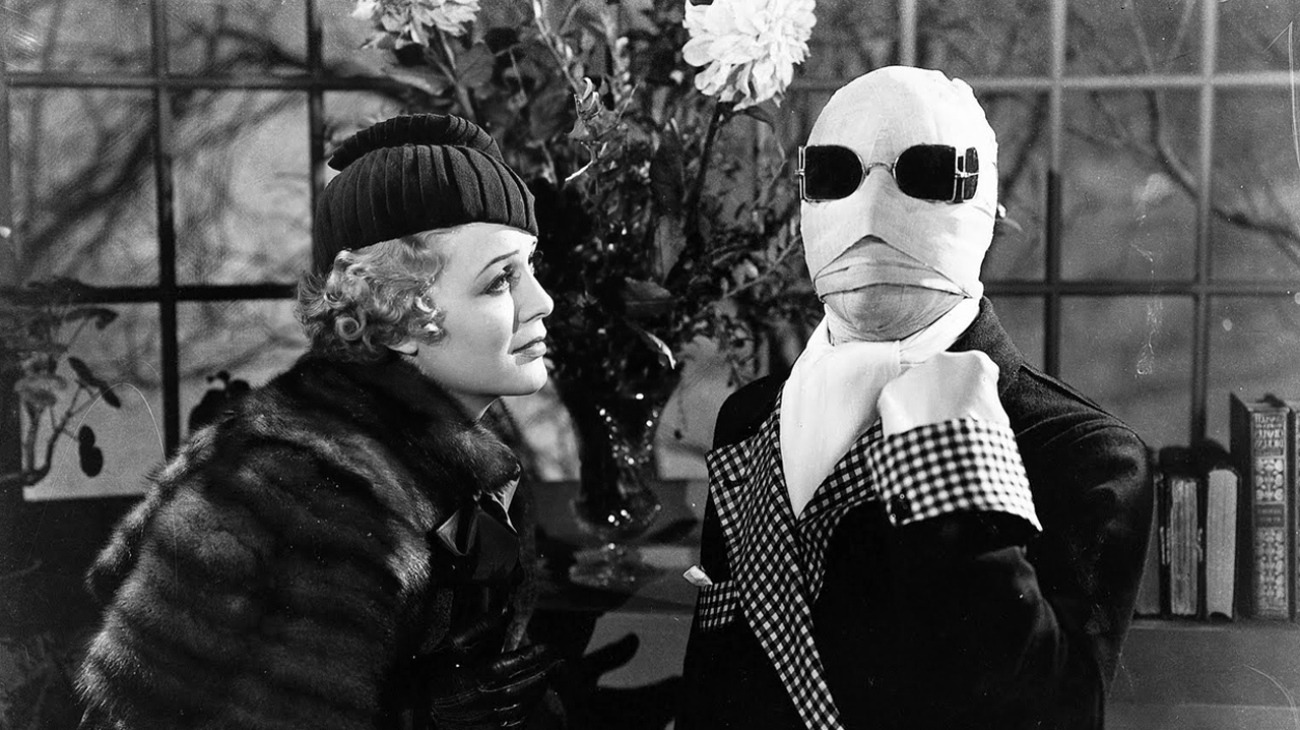
Coming from a stage acting background, Rains delivers a larger-than-life performance filled with dramatic gestures, booming speeches, and manic energy.
Directed by James Whale, best known for Bride of Frankenstein, and written by R.C. Sherriff based on the novel by H. G. Wells, The Invisible Man stars Claude Rains as Dr. Jack Griffin, alongside Gloria Stuart, William Harrigan, and Henry Travers.
When people are asked what superpower they’d most like to have, invisibility is usually near the top of the list. After watching The Invisible Man, though, some people might reconsider. In this version of invisibility, there are some serious side effects.
The film opens with Dr. Griffin arriving at a small village inn during a snowstorm. Wrapped in a heavy coat, gloves, dark goggles, and facial bandages, he immediately creates an unsettling impression. The locals are curious—and more than a little suspicious—about the mysterious stranger who has suddenly appeared.
Griffin rents a room and begins setting up a makeshift laboratory. His goal is to find a cure for the invisibility he inflicted upon himself through experimentation. Unfortunately, the innkeepers constantly interrupt his work, and his frustration eventually boils over. When it does, he embarks on a destructive crime spree that quickly grabs the attention of both the local community and the authorities.
After making headlines, Griffin seeks out his former colleague Dr. Kemp (Harrigan) and reveals the truth: he really is invisible. But by this point, the chemical responsible for his condition has begun affecting his mind. What starts as a desperate search for a cure transforms into dreams of world domination. Griffin becomes convinced that invisibility can bring limitless wealth and power, and he imagines creating invisible armies that governments could use to conquer the world.
The movie’s biggest strength is undoubtedly Claude Rains. Coming from a stage acting background, Rains delivers a larger-than-life performance filled with dramatic gestures, booming speeches, and manic energy. In most films, that style might feel excessive, but here it works perfectly. Griffin is a man whose sanity is rapidly slipping away, and Rains embraces every moment of it.
What really makes the performance memorable is his voice. Since Griffin spends much of the movie invisible, Rains often has to carry scenes with vocal performance alone. His commanding delivery, sinister laughter, and gradual descent into madness make the character genuinely intimidating. By the end of the film, his gleeful cackling is almost as frightening as anything he actually does.
Unfortunately, the rest of the cast struggles to keep up with him.
Gloria Stuart plays Flora, Griffin’s former love interest, but she’s saddled with one of those typical 1930s female roles where her primary function is to worry about the male lead. Most of her scenes involve fretting over Griffin’s safety or wondering if he’ll return. The other major female character, one of the innkeepers, spends much of the movie screaming. It’s a reminder of how limited many female roles were during this era of film-making.
Even though The Invisible Man is over ninety years old, and yet many of its visual effects remain remarkably convincing. Modern viewers generally understand how the invisibility effects were achieved, but that knowledge doesn’t lessen their impact. Watching bandages unwrap themselves, doors open seemingly on their own, or objects float through the air is still impressive today. The practical effects are equally effective. Wire work, moving props, and miniature photography all hold up surprisingly well. There are moments where the effects show their age, but they’re far more successful than I expected from a film made in 1933.
James Whale’s direction deserves a lot of credit for that. He keeps the movie moving at a brisk pace, and at just over seventy minutes long, the film never drags. Whale also balances horror, comedy, and suspense in a way that feels surprisingly modern. Griffin often commits acts of violence while laughing hysterically, creating an unsettling mix of humor and menace.
And speaking of violence, if you’re judging Universal Monsters by their body count, Griffin might be the most dangerous of them all. He racks up an impressive number of victims throughout the story. Many of the deaths happen off-screen, but there’s no question that this version of the Invisible Man is far more murderous than characters like Dracula, Frankenstein’s Monster, or the Creature from the Black Lagoon.
Going into the film, I honestly underestimated it. I expected something quaint and maybe a little slow-moving. Instead, I found an energetic, entertaining horror film anchored by an unforgettable performance from Claude Rains. The effects remain impressive, James Whale’s direction is excellent, and there are even some fun blink-and-you’ll-miss-them appearances from genre actors like Dwight Frye, Walter Brennan, and John Carradine.
Most importantly, I think this is still a movie that modern audiences can enjoy. If viewers can get past the fact that it’s black and white, they’ll discover a fast-paced horror classic that remains surprisingly entertaining nearly a century later.
4.0 out of 5.0 stars


