
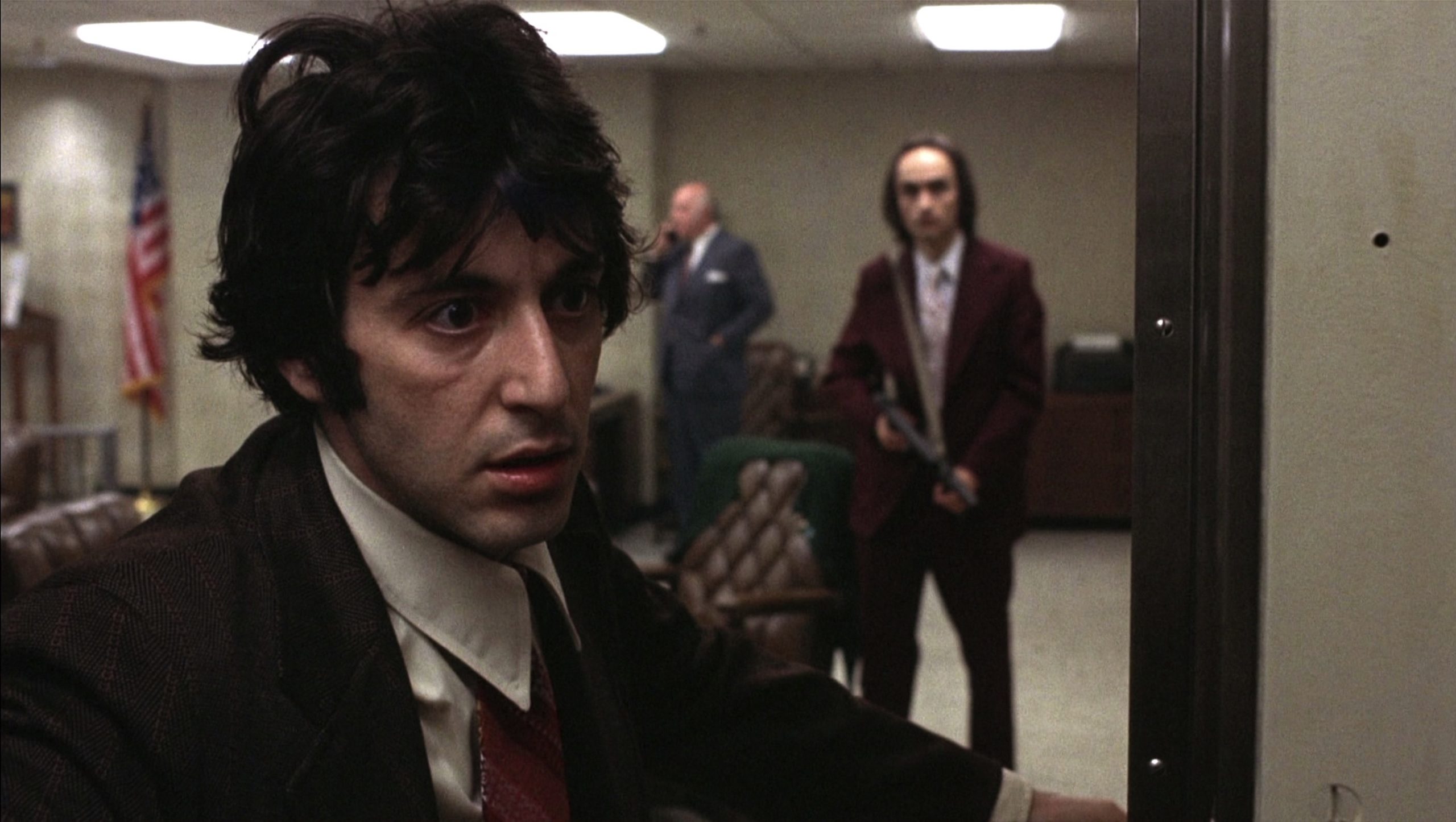
It’s gritty, it’s fascinating, it’s incredibly ’70s, and it’s a masterclass in filmmaking and acting.
Dog Day Afternoon was directed by Sidney Lumet and written by Frank Pierson. The film stars Al Pacino, John Cazale, Charles Durning, and Chris Sarandon. It’s based on the true story of a bank robbery that took place in Brooklyn in August 1972.
From the beginning, it becomes obvious that this isn’t going to be your typical crime movie. Almost everything that can go wrong for first-time bank robbers Sonny and Sal goes wrong. Their partner chickens out almost immediately, the bank has very little money because the day’s cash pickup has already happened, and Sonny manages to alert the police to the robbery despite knowing exactly how bank alarms operate. What was supposed to be a quick robbery turns into an hours-long standoff involving the police and eventually the FBI.
What makes the situation fascinating is Sonny himself. He doesn’t behave like the stereotypical hardened criminal. He’s emotional, nervous, and clearly in over his head, but he’s constantly trying to project an image of someone who’s calm and in control. That façade begins to crumble as the situation gets worse, particularly once the television cameras arrive.
Al Pacino is absolutely phenomenal in this movie. He’s on screen for much of the film, and Lumet’s camera captures every nervous gesture, facial expression, and change in Sonny’s demeanor. As the standoff continues, you can practically watch Sonny’s emotional state deteriorate. It’s an incredibly nuanced performance, and it’s one of the best performances I’ve ever seen from Pacino.
Sidney Lumet’s direction is a huge part of what makes the movie work. Lumet was known as an actor’s director, and that really shows here. The film doesn’t waste time giving us a lengthy introduction to these characters. The movie starts, the robbery starts, and we’re immediately thrown into the situation. And when the camera leaves the bank, it’s generally to give us additional information about Sonny and the circumstances that made him the conflicted person we’re watching.
Charles Durning is also excellent as Detective Moretti. There’s a dialogue exchange between Moretti and Sonny that is one of the highlights of the entire movie. The characters talk over each other, repeat themselves because they weren’t heard, and carry on conversations the way people actually do when they’re under pressure. It’s fantastic writing and directing, and Durning and Pacino play it beautifully.
John Cazale gives a much more restrained performance as Sal, but that restraint works perfectly. Sal feels like a ticking time bomb sitting in the background. You never quite know what he’s going to do, and that uncertainty adds another layer of tension to the situation.
One of the most interesting aspects of the movie is the revelation about Sonny’s sexuality. What I really appreciate is that the film doesn’t suddenly turn that revelation into a stereotypical subplot. Instead, it simply gives us another piece of the puzzle when it comes to understanding Sonny. Chris Sarandon, as Leon, Sonny’s “wife,” delivers an exceptional performance that earned him an Academy Award nomination for Best Supporting Actor. His scenes further illustrate just how complicated Sonny’s life is and help us understand why he’s so conflicted.
Interestingly, the reaction of the crowd outside changes when Sonny’s sexuality becomes public. Initially, the crowd seems to support him, almost turning him into a celebrity. But once that information comes out, some of that support disappears. It’s a subtle but important moment that says a lot about the time period.
What ultimately what makes Dog Day Afternoon so effective is that although it’s a crime movie, it’s really more of a character study. The robbery is the framework, but the movie is primarily interested in the people involved and the circumstances that brought them there.
This is a movie that’s difficult to describe in a short review because there’s just so much going on beneath the surface. It’s funny without being a comedy. It’s dark without being depressing. And despite the fact that we’re watching a bank robbery, there really isn’t much conventional action. This isn’t a shoot-’em-up crime movie. It’s about character, acting, dialogue, filmmaking, and watching a situation slowly spiral out of control. And that’s exactly why I love movies like this.
By the end, you become so invested in Sonny and Sal that you almost forget you’re watching actors. You feel like you’re watching an actual bank robbery unfold in real time. That’s the mark of an incredible performance and an incredible film. The two-hour runtime absolutely flies by, and Dog Day Afternoon is one of those movies that reminds me why I love movies in the first place.
Al Pacino’s performance is, in my opinion, one of the best of his career. I haven’t seen every movie he’s made, but I’d be hard-pressed to name a better performance than what he gives us here. If you haven’t seen it, I highly recommend checking it out. It’s gritty, it’s fascinating, it’s incredibly ’70s, and it’s a masterclass in filmmaking and acting.
5.0 out of 5.0 stars

