
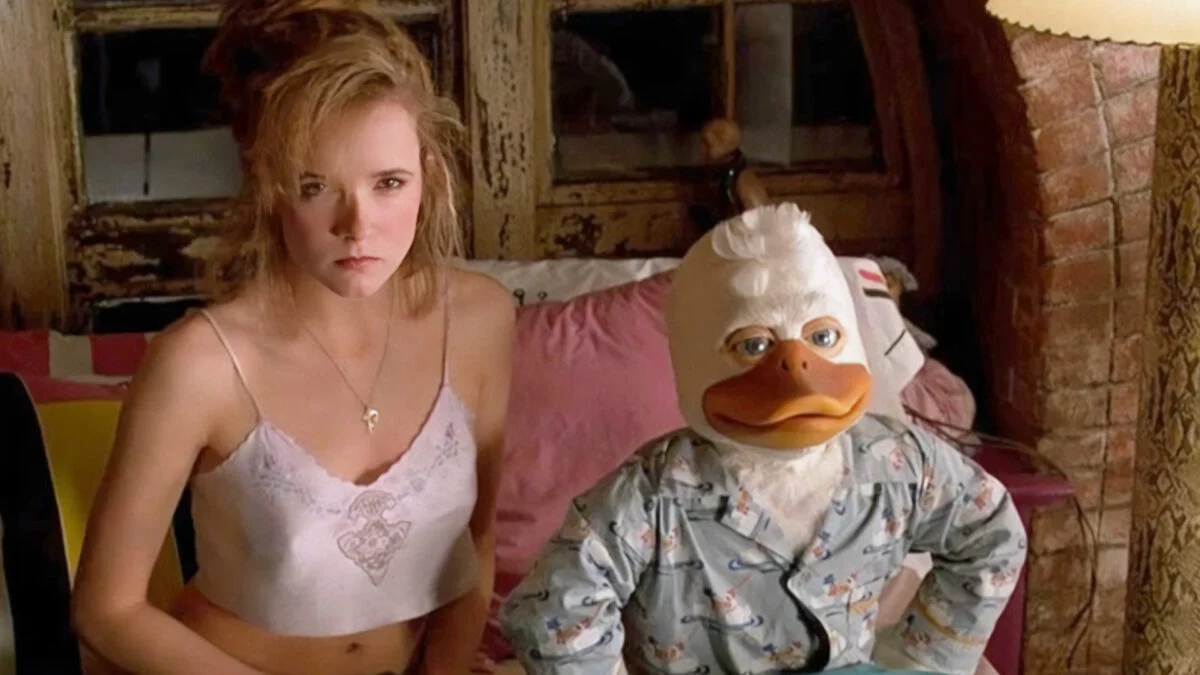
It’s so baffling, so misguided, and so tonally confused that it becomes weirdly fascinating.
Well, I knew this day would come—the day I’d finally sit down and watch 1986’s Howard the Duck. I’d always heard it was bad, but I figured that was just exaggerated ’80s backlash. Surely it couldn’t be that terrible. It really is.
The movie follows Howard T. Duck, yanked from Duckworld and dropped into Cleveland, Ohio. (Though judging by the palm trees, this “Cleveland” is very clearly San Francisco.) After saving Beverly (Lea Thompson) from some of the most unrealistic street thugs the city has ever seen, Howard ends up staying with her. Their relationship forms way too fast and way too creepily. Beverly brings in her friend Phil (Tim Robbins), a lab assistant who tries to help Howard get home. Instead of helping, their experiment summons the “Dark Overlord of the Universe,” and Howard is forced to battle it.
As the movie went on, I kept asking myself: Who was this made for? The original comic’s sarcastic, cigar-chomping Howard is nowhere to be seen. Instead, the film leans heavily on slapstick, physical comedy, and furniture-breaking, all while delivering humor that’s bizarrely adult. Duck nudity, condoms, and sexual innuendo? In a PG movie marketed to kids? I can only imagine the parents who walked out of this shell-shocked.
The animatronic duck suit doesn’t help. Eight performers operated Howard at various times, and the different suits are all slightly different sizes. Howard basically fluctuates in height and weight from scene to scene like he’s retaining water.
The cast on paper is impressive: Lea Thompson, who honestly is the reason I didn’t shut the movie off; Tim Robbins, who plays a manic sidekick; and Jeffrey Jones, who still feels like the principal from Ferris Bueller wandered onto the wrong set. But their performances can’t save a film this chaotic.
William Huyck’s direction is hyperactive to the point of exhaustion. The dialogue feels like it was written and delivered under a mountain of cocaine. George Lucas backed the movie financially, and its failure forced him to sell off Lucasfilm’s computer animation division—which went on to become Pixar. So if we owe Howard the Duck anything, it’s that.
The film is overflowing with explosions, lasers, endless duck puns, strange romantic tension between a woman and a duck, and a bunch of goofy pop songs co-written by Thomas Dolby. The closing track, “Howard the Duck,” was Razzie-nominated but, honestly, it’s one of the most enjoyable things in the whole film.
Speaking of Razzies, the movie won four, including Worst Picture, tied with Under the Cherry Moon. And I get it. Completely.
Still, I do see how this became a cult movie. It’s so baffling, so misguided, and so tonally confused that it becomes weirdly fascinating. It’s a case study in how a movie gets green-lit despite no one having any idea who the audience is supposed to be.
There are tiny silver linings—Lea Thompson is incredibly charming, Holly Robinson Peete shows up in her first film role, and Tim Robbins at least seems like he’s having fun even when the script isn’t helping him.
In the end, Howard the Duck is a bizarre cinematic artifact. The story of how it was made is probably more interesting than the film itself.
1.0 out of 5.0 stars

