
If the original isn’t accessible to you, this version is absolutely worth your time.
The 1997 remake of 12 Angry Men had a lot to live up to. The 1957 original—anchored by Henry Fonda, E.G. Marshall, Jack Klugman, and Lee J. Cobb—is not only a classic, but one of the best films I’ve ever seen. It’s stayed fresh in my mind since my last viewing, and confidently sits in my personal top ten. So going into this version, I was understandably skeptical. How do you improve on near perfection?
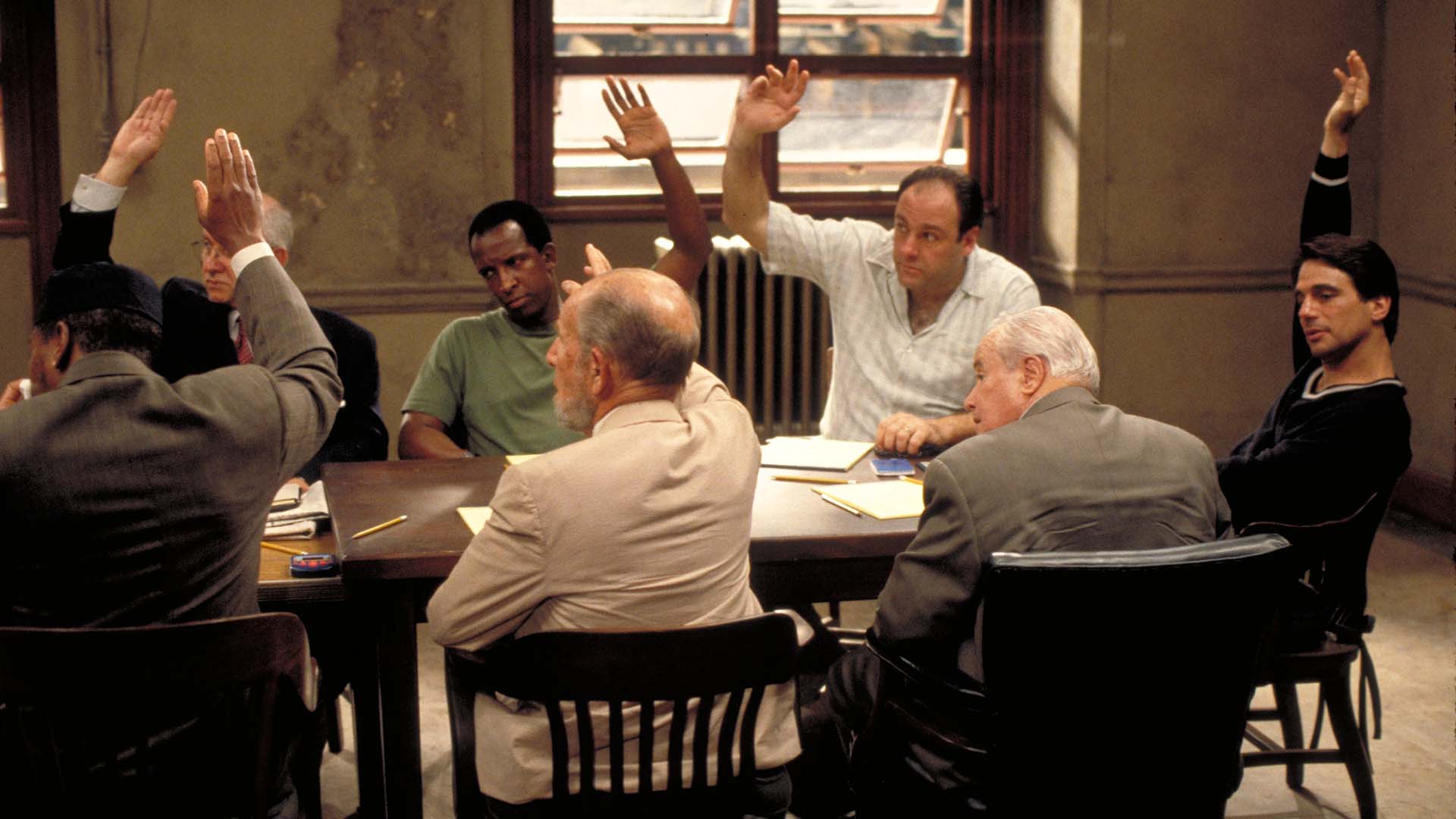
One smart way is to bring back the original writer. Reginald Rose returned to update his own teleplay, and with William Friedkin directing, the film already had a solid foundation. Though made for Showtime in 1997, this TV movie boasts an astonishing cast: Jack Lemmon, George C. Scott, Tony Danza, James Gandolfini, Hume Cronyn, Mykelti Williamson, Ossie Davis, Dorian Harewood, Courtney B. Vance, Edward James Olmos, William Petersen, and Armin Mueller-Stahl. Every single one of them delivers.
Aside from updated cultural references, the biggest change is the more diverse cast, which brings new textures to the dynamics in the jury room. The use of handheld cameras adds an immediacy missing from the original’s old-school studio style. It helps the film feel more grounded and gives the tension a modern edge.
If you’ve somehow missed 12 Angry Men, the setup is simple: twelve jurors in a room debating the guilt of a young man accused of murder. Juror #8—played thoughtfully by Jack Lemmon—casts the lone “not guilty“ vote, not because he’s sure of the boy’s innocence, but because he believes there may be reasonable doubt. As he questions the others, the drama becomes a gripping exploration of personal bias, emotional baggage, and the fragile nature of justice.
It might sound like “two hours of people talking,” but what they say and how they say it is what makes the film riveting. Even without knowing their names, the characters are so well-drawn that you see them evolve as the discussion unfolds.
My wife happened to catch the last few minutes with me and remarked that it felt like something you’d watch in a film class and that’s exactly right. Like the original, this version is layered, study-worthy, and rich with detail. The set is minimal, encouraging you to focus entirely on the performances and dialogue. My only critique is that the set sometimes looks like a set, which breaks the immersion a bit.
While the film doesn’t surpass the original, it absolutely stands on its own. George C. Scott gives the standout performance of the ensemble, though everyone shines. It’s also notable as Scott’s final film, and features Gandolfini and Petersen before their iconic turns in The Sopranos and CSI.
If you’re planning to watch it, avoid the Amazon Prime version. The stream is stuck in a poor-quality 4:3 transfer that looks like 480p. Instead, hunt down the Kino Lorber Blu-ray, which includes a fantastic widescreen version that looks far better and may have been prepared for a theatrical presentation.
This remake doesn’t eclipse the 1957 masterpiece, but it doesn’t need to. It remains a powerful, excellently acted film that honors the original while offering its own strengths. If the original isn’t accessible to you, this version is absolutely worth your time.
4.5 out of 5.0 stars

