
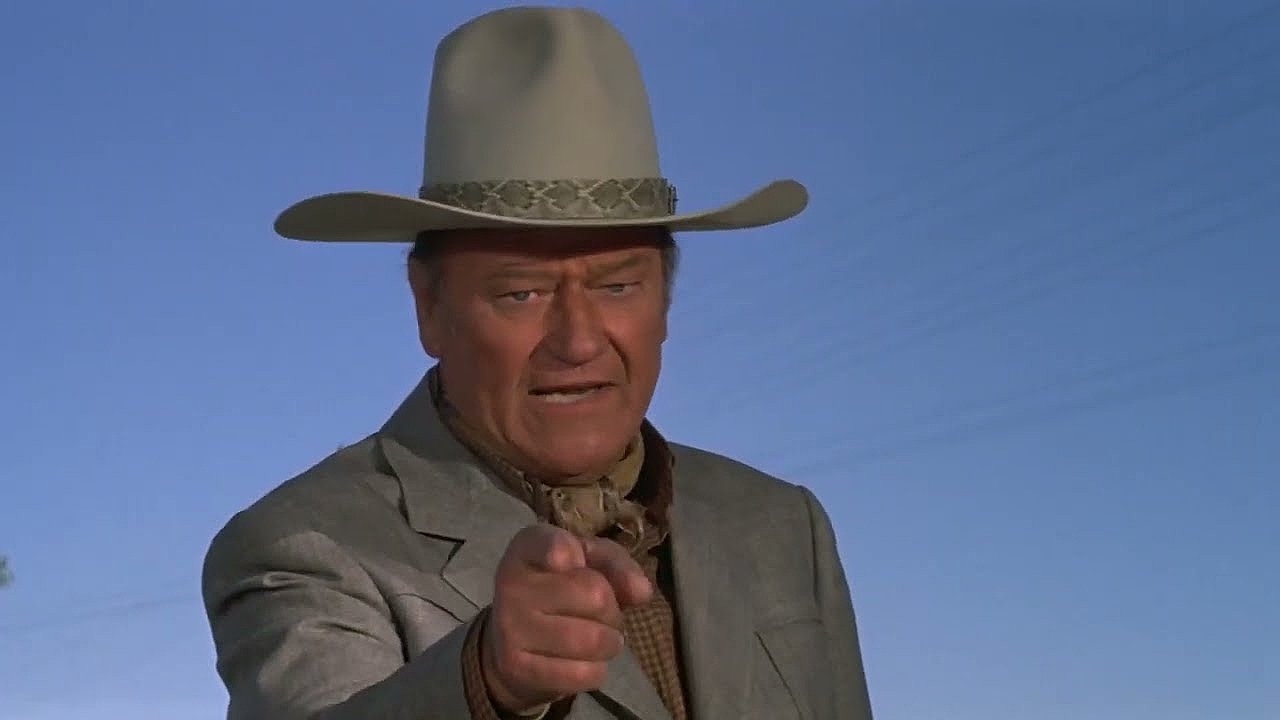
Fans of Wayne will likely enjoy spending another couple of hours with one of cinema’s greatest screen icons, but newcomers looking to explore either John Wayne or the Western genre would be better served starting elsewhere.
John Wayne made more than 170 films during his legendary career, and by the time Big Jake arrived in 1971, he had become an institution. Released just seven films before his retirement, this Western feels like a comfortable victory lap rather than an attempt to break new ground.
Directed primarily by George Sherman, with Wayne stepping in behind the camera when Sherman became ill, the film was written by Harry Julian Fink and R.M. Fink, the same duo who would later write Dirty Harry and create its iconic title character.
Wayne stars as Jacob “Big Jake” McCandles, an estranged rancher summoned back by his wife Martha (Maureen O’Hara) after their grandson is kidnapped by ruthless outlaw John Fain, played by Richard Boone. Jake gathers a small posse consisting of his sons James (Patrick Wayne) and Michael (Christopher Mitchum), along with his longtime Native American tracker Sam Sharpnose (Bruce Cabot) and his loyal dog — simply named Dog — to hunt down the kidnappers before it’s too late.
The plot is about as straightforward as Westerns come. There’s never much mystery about where the story is headed, and that’s both the film’s greatest strength and greatest weakness. It embraces familiar genre conventions without trying to reinvent them, making it an easy, comfortable watch but rarely an exciting one.
One interesting wrinkle is the setting. Taking place in 1909, Big Jake exists during the transition from the Old West to the modern age. Automobiles and motorcycles make appearances, with the local sheriff believing new technology is the future of law enforcement. Jake, however, sticks to horses, tracking skills, and old-fashioned experience. Unsurprisingly, the movie argues that the old ways still work best, using its rescue mission as a metaphor for tradition triumphing over modernization.
Wayne himself gives one of the safest performances of his career. Big Jake is essentially John Wayne playing the version of John Wayne audiences already knew and loved. The film repeatedly reminds viewers of Jake’s fearsome reputation, but it rarely shows us why he’s earned it. Instead, it relies on Wayne’s decades of screen persona to do the heavy lifting. The audience is simply expected to believe that Big Jake is a legend because John Wayne is playing him.
Richard Boone is easily the film’s standout supporting player. His charismatic performance gives Wayne someone capable of matching him on screen, and the scenes they share are the movie’s highlights. Unfortunately, the rest of the supporting cast is far less memorable. Even Maureen O’Hara, reunited once again with Wayne, has little to do and feels like she’s coasting through a brief appearance.
Tonally, the film is a bit uneven. Much of the middle section leans heavily into slapstick comedy, aided by an oddly lighthearted score from Elmer Bernstein that often undercuts the action. Then, almost without warning, the climax becomes surprisingly violent, creating a noticeable shift that doesn’t always feel earned.
Ultimately, Big Jake isn’t a bad movie. It just never strives to be anything more than a familiar John Wayne vehicle. It’s predictable, uncomplicated, and comfortable. Fans of Wayne will likely enjoy spending another couple of hours with one of cinema’s greatest screen icons, but newcomers looking to explore either John Wayne or the Western genre would be better served starting elsewhere.
3.0 out of 5.0 stars

